


As a self-confessed “word merchant,” I must admit I often find my writings to be led or directed not only by deciphering the use of one’s chosen words; but just as importantly, by what I perceive to be their use or misuse from a certain perspective, or “world view,” as well.
That same risk -- or challenge -- is not just limited to perhaps the most obvious among us; namely, those preachers and politicians who may be tempted or inclined to utter whatever they think we want to hear; while at the same time, there might be that reactionary remark uttered by the listener to what may seem to them to be incredulous. “He / she said WHAT?!” It’s a familiar refrain.
When One Goes Off-script, or What Might Become “Script-ure”
There are numerous colloquial expressions when it comes to speaking, writing, quoting or misquoting someone else. There are those who will say one thing, and then do something else. One might claim to be misquoted or claim a remark has been taken “out of context.” Then there are those who seem to “speak out of both sides of their mouth,” and consequently fail to “practice what they preach.”
When it comes to those numerous gospel narratives in that collection known as “canonized” scriptures, there’s not only been an unending debate among biblical scholars with regards to what the historical Jesus may have actually said; but more so, what he may have meant by those words he may, or may not, have uttered. In last month’s commentary, “Swear to God,” I cited examples of contradictory expressions that all claimed to be authoritative and divinely inspired; suggesting that perhaps the best course was to actually “cherry pick” those sayings and teachings one instead found to be most authentically, personally true.
Be Careful What You Say
“Honor your father and mother” (Matthew 15:4)
“If anyone comes to me and does not hate father and mother, wife and children, brothers and sisters—yes, even their own life—such a person cannot be my disciple” (Luke 14:26).
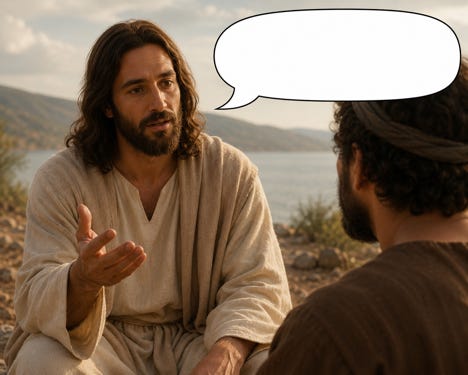
As a boy, “Be careful what you say,” were those cautionary words of advice I’d often hear my loving mother quietly murmur to me. The two scripture quotes above -- recorded by two different evangelists that asserted presumably uttered by Jesus -- are sometimes explained away as excessive hyperbole. But here’s the question: If you were asked to be your own spokesperson, or author of your own life tale, what utterances might you use, borrow, adapt from the recorded “sayings” and teachings of Jesus, the Galilean peasant sage?
If you were to be your own spokesperson, or author of your own life tale – instead of filling in that blank caption in the graphic above -- what utterances might you use, borrow, adapt from the recorded “sayings” and teachings of Jesus, the Galilean peasant sage?
The Gospel According to Who, … or What?
By ___________ (Authorship Unimportant)
David Galston is a biblical scholar who has spent decades deciphering and debating the authenticity of the sayings attributed to the historical Jesus. But in a recent article, he suggested that Christianity might have a brighter future if hearers of those words focused less on authorship, and more on the “spirit” of what the early Christian communities had derived from the oral tradition around which they had arisen. The eventual, scripted gospels were documents of anonymous authorship. “Being in the spirit, in Christianity, means being in the resurrection,” says Galston. Then he elaborates,
“The resurrection, properly understood, is the spirit of the Jesus movement and not something that happened to Jesus. Being in the resurrection meant participating in a spirit of life or a way of life that does not belong to individuals. Nothing about being in the resurrection relates to persona status. The saying that there is “no male or female, no Jew or Greek, no slave or free” (Gal. 3:28) means that the gathered community holds a common spirit that cancels or makes anonymous personal identities.”
What might that mean? Galston continues,
“’Being in the resurrection’ even applies to the life of the historical Jesus. There is a sense in which the historical Jesus was already ‘resurrected,’ that is, he already lived in the spirit of what he called the ‘empire of God.’ It was his ability to live according to an alternative reality index, that is, a different sense of being in the world, that made his historical life a representation of a new order.”

Just as important, what might that mean? “Christianity,” he says, “is, or can be, the permanent critiques of politics because it speaks from outside the individualism and heroism needed to promote the political will.”
As a long-time progressive pilgrim in the Christian faith tradition, I’ve sought to not only discover what the historical figure from Galilee might have actually said; but what he possibly meant by what he said, as well. As I suggested in my last commentary, it’s not just a matter of seeking to grasp what may have actually been said (as opposed to what we might mistakenly hear, or want to hear); but of embracing and becoming the living embodiment of something authentic and consequently most meaningful.
[1]David Galston, The Fourth R, July-August 2026
© 2026 by John William Bennison, Rel.D. All rights reserved.
This article should only be used or reproduced with proper credit. To read more commentaries by John Bennison from the perspective of a Christian progressive go to Words & Ways here. Do you live in the San Francisco Bay Area. Check out Pathways Faith Community here.
NOTES TO MY READERS: Words & Ways is offered freely to all. If you find value in these commentaries and would like to help sustain this work, you’re warmly invited to become a supporting subscriber. Any contribution goes entirely toward covering the costs of this publication - not toward generating income. I’m only seeking thoughtful dialogue, and I’m grateful for your readership whatever form that takes. Support Words & Ways: wordsnways.com/subscribe
Norm, thanks very much for sharing your own fine description of our shared journey
John: This is brilliant writing. The Galston reference makes it plain.
Resurrection means "being in the spirit." Properly understood, it is the spirit of the Jesus movement, not something that happened to Jesus. It is a way of life that doesn't belong to individuals, completely unrelated to personal status.
That message liberates us. It creates a community forged by a shared, common spirit. More importantly, it unchains the biblical narrative from the literalism—and the resulting, tired antagonism with science—that plagues the old two- or three-story universe model.
Pierre Teilhard de Chardin captured this exact liberation. We are caught up in the sweep of history—not just as Homo sapiens, but as part of the universe itself moving toward the Omega Point. It is evolution folding back upon itself, expanding consciousness into a completely new order.
Nice work. Thanks.