


Last month, at the Museum of the Bible in Washington, D.C., there was a week-long marathon, where participants met the challenge to read the entire compendium of those ancient texts, cover to cover. Wow. That’s sixty-six books (in the Protestant version), and anywhere from 1,000 to 1,500 pages.
The event was held to commemorate the approaching 250th anniversary of the United States; claiming to be “one nation, under God.” Historians would remind us that the claim our nation is under such divine rule wasn’t added until a joint congressional resolution was passed in 1954. The current rise of the political/religious movement commonly referred to as Christian Nationalism is the latest example of trying to reconstruct what seems to be a recurrent misrepresentation in an historical cycle; trying to keep a certain separation between church and state.
Nonetheless, the current occupant of the White House participated in the recent commemorative event by sitting behind his desk in the Oval Office; and reading a portion II Chronicles 7:11-22. One might wonder if he selected the passage himself as one of favorites. II Chronicles is a book from the Hebrew Torah, and in this one particular English translation it reads,
“If my people, which are called by my name, shall humble themselves, and pray, and seek my face, and turn from their wicked ways; then will I hear from heaven, and will forgive their sin, and will heal their land.” (I’ve selectively italicized the word ‘humble’ for emphasis. More about that later.)
Cherry Picking “Holy” Scripture
So, we have this compendium of ancient texts, commonly known as the Bible. Beginning in the 6th or 7thcentury BCE, and for more than two millennia thereafter, it has been revered and deemed by many to be holy, sacred, and the authoritative “Word of God.” This has been the case beyond even those claiming to be “religious.” Witnesses in a civil court will stand before a judge -- or presidents take an oath of office -- by placing their hand on a stack of Bibles, and swear to tell nothing but the whole truth, “so help me God.”
As such, what then is the truth, or a mistruth, according to the Bible; especially when it comes to taking a vow to tell the truth by you, me, or our brother Donald?
As such, what then is the truth, or a mistruth, according to the Bible; especially when it comes to taking a vow to tell the truth by you, me, or our brother Donald?
One might recall that’s the same question that was put to Jesus by Pontius Pilate, in Jesus’ trial, and subsequent crucifixion (John 18:38). According to John’s gospel, their conversation ends with that hanging question. Was it meant to be merely a lingering puzzlement; or a rhetorical question, inviting us to return, once again, to the life teachings of that Galilean peasant sage? The depicted Jesus character for this particular early pre-Christian faith community was provided no further opportunity to receive any further “teaching moment” to the gospel message that had preceded it. The oral tradition already underway was all that was left to decipher, interpret and pass along.
But as a matter of fact, when it comes to the question of the “truth,” it’s not just about some kind of unveiling or revelation (that is, revealing the “facts” as we’re able to know or discern them), but interpretation, and then application of a discernible “truth.” That’s where the teaching (or preaching) about what one has been given and learned comes into play; and not just merely mumbling and jumbling a bunch of words that have merely been deemed to be “holy writ.”
The further problem, of course, is that in those many pages between the front and back of that revered book there are completely contradictory claims, proclamations, commands, and teachings. That’s when plucking a particular chapter and passage from one particular page can be conveniently used to defend or justify any human action, or interaction. Another example:
Recently, Secretary of War, Pete Hegseth was presiding over a prayer meeting at what has been re-named the Department of War, when he drew upon Psalm 22:1 to eulogize a fallen service member and justify the U.S. attack on Iran. “Blessed be the Lord,” he uttered, “my rock, who trains my hands for war and my fingers for battle.” Subsequently, it has been reported that Pete misquoted Ezekiel 25:17; adapting language about wreaking “great vengeance” from heaven upon his enemies. It was later revealed to be a direct quote – word for word – from Quentin Tarantino’s hit film, “Pulp Fiction.”
The use, or mis-use, of biblical quotes is a common occurrence, of course; commonly known as “proof-texting.” Here’s the critical question: How does one sort and distinguish what is asserted to be not only authoritative, or providential; but truly, personally “true?”
How does one sort and distinguish what is asserted to be not only authoritative, or providential; but truly, personally “true?”
If Donald, or Pete, or you, or I were to step up into a pulpit to preach about what so many claim to be either divinely-inspired or simply, authentically true, what chapter and verse, mythic tale or parable, psalm or prophecy might you select to interpret and proclaim?
This is the same question that could be posed to both a Christian fundamentalist, or literalist; as well as those learned, Biblical scholars who endlessly study and debate who recorded and wrote which scripture, and what they might have interpreted and meant; along with those who inherited these ancient texts centuries and centuries later.
“Proof-texting” scripture to defend or justify one’s actions may either be enlightening and edifying; or a blasphemous misuse of such texts that have been deemed by so many to be authoritative in one way, or another. But since the Bible is full of contradictory claims and assertions, a more honest approach might actually be to cherry-pick those sayings, teachings and tales one has found to be most authentically “true.”

In Luke’s gospel there is the story of a 12-year old Jesus. It follows Luke’s quaint version of Jesus’ nativity. In the story he’s wandered off and his parents are desperately looking for him. They are both relieved and astonished to find him teaching and preaching in the Jerusalem temple; where “all who heard him were astonished by his understanding and answers .” (Lk. 2:47)
Then there’s that other story from Matthew’s gospel about Jesus, the itinerant preacher who was never welcomed back into the temple to preach or teach; especially after driving out the tax collectors and merchants from what he reportedly called a “den of thieves;” only to welcome the poor and lame in their place. (Mt. 21:12-13) It leaves me to remember and wonder about this:
The Christian faith tradition provides us with many and varied gospel stories that read like a bio-drama. (I wrote an earlier commentary on Jesus the satirist and blasphemer here). Similarly, we may all have our favorite passages that “ring true” for us; and others that do not. How then to tell the “truth?
We may all have our favorite passages that “ring true” for us; and others that do not. How then to tell the “truth?
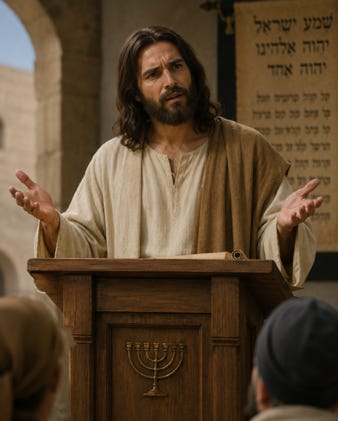
If that Galilean itinerant sage were to ever ascend a pulpit, what would he truly teach and preach from all the stories and sayings subsequently attributed to him? To tell the truth, the whole truth, and nothing but the truth -- from the different sketches we have of him – I’d lay my bet on such sayings as the beatitudes, the example of kindness shown by the alien stranger, the father’s gift of grace to the prodigal son, the rejection of vengeance and retaliatory violence, and sowing seeds of faith, hope and charity.
Such a bountiful harvest of such selectively picked “cherries” would likely be those truly worth hearing, embracing and living-out, once again.
© 2026 by John William Bennison, Rel.D. All rights reserved. This article should only be used or reproduced with proper credit. To read more commentaries by John Bennison go to the Archives here.
Thank you for your thoughtful contribution to the dialogue. Historically, it seems the two ways humans attempt to construct order out of chaos (our political and religious structures) only perpetuate more of the same. The "ethical option" to which you refer rarely prevails. With hope, however, it does endure.
Reading the Bible from cover to cover can give the reader a sweeping account of the moral struggles humanity has wrestled with for millennia. But often — very often, in my observation — people use the Bible as a mirror reflecting their own confirmation biases, fears, and assumptions.
Of course, it’s not just religion. We see the same tendency in the constitutional originalism of the Supreme Courr, in legal arguments shaped by advocates like Pan Bondi and Todd Blanche, or in political philosophies advanced through efforts like Project 2025 and Russell Vought. All this reaching a clarifying and terrifying climax in the narcissism of Donald Trump. Rather than understanding the broader context and sweep of a document, people isolate a passage — or cherry-pick a phrase, as you put it — and build an entire narrative around it.
That’s why I appreciated your larger point: the essence of Christianity is less about authority and doctrine than about ethical orientation and human conduct. Well said.