


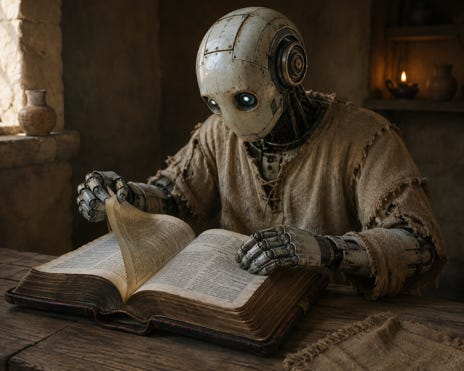
“Jesus loves me, this I know …
For the Bible tells me so.”
Hymn by Anna Barrett Warner, 1859, based on I Cor. 6:19
Looking for a quick and easy answer to your life’s questions? Just ask your always-ready, quick-and-easy generative Ai bot to give you all the facts you could ever know, and trust, right? Hmmm …
Long before life’s answers were as close and readily available as the cell phone in your hip pocket, there were only those much more antiquated and unreliable resources available. There were philosophers and prophets, preachers and politicians. Such resources have also historically included what has been deemed by millions of people for millennia to be “holy scripture.”
Why this? Why that, you may ask? Well, just as you may have sung in Sunday School, because the Bible tells you so. But even less reliable, perhaps, is the presumptuous divide between what one might consider fanciful fiction or alleged to be biblical non-fiction. So, who -- or what -- can you ever dare trust, or en-trust, with your own life’s story; giving you a sense of order out of the perpetual chaos of this world?
Of course, as pointed out in an earlier, recent commentary, the only problem -- for those willing to acknowledge it -- is that the compendium of human writ we call the Bible is actually comprised of many contradictory claims and statements. As a result, my recommendation was to first acknowledge that simple fact; and then to simply relinquish the need for any such absolute certainty, and instead “cherry-pick” those tales and teachings that rang true for you in your own life’s experience of reality. So, what is not simply factual, but true or not true, when it comes to that deeper sense of any expression of trust-worthy “reality?”
When I recently asked ChatGPT what was “real” or “artificial” about Ai, it quickly, dispassionately and patiently explained to me:
Artificial” in AI mainly means human-made rather than naturally occurring. AI is artificial in a few important senses:
Artificial intelligence is engineered. Humans build the algorithms, computer systems, and training processes that produce its behavior.
Its “knowledge” is learned from data. An AI model doesn’t grow up, experience the world, or learn in the biological sense. It adjusts mathematical parameters based on enormous amounts of examples.
Its intelligence is simulated through computation. When an AI writes, reasons, recognizes images, or answers questions, those abilities arise from computational processes rather than a biological brain.
It doesn’t necessarily have a mind like ours. An AI can produce remarkably intelligent-seeming behavior without that proving it has consciousness, feelings, desires, or subjective experience.
Perhaps the most interesting point imparted by Ai was that “artificial” doesn’t necessarily mean “fake.” A calculator performs real calculations even though it isn’t a human mathematician. Similarly, Ai can perform genuinely useful forms of reasoning or pattern recognition, even though its intelligence is produced differently from ours.
So, perhaps the deeper question is this: If something behaves intelligently, but isn’t biological, is it actually intelligent—or merely an extremely convincing simulation of intelligence? That’s where computer science, philosophy, and neuroscience start getting tangled together.
“Human-made … based on an extremely convincing simulation of intelligence … where computer science, philosophy, and neuroscience start getting tangled together.” OK. In this case, it causes me to wonder if -- long before the invention of computational data -- there weren’t those earlier humanly-imagined mythic tales and philosophical teachings that ended up in some of those ancient biblical texts?
Fiction, Non-Fiction and the Imaginary Divide
Trust in the Lord with all your heart and lean not on your own understanding; in all your ways submit to him, and he will make your paths straight. [Proverb 5:3-6]
When it comes to the entire biblical oral tradition, one could readily conclude it is comprised of both fact and fiction. For instance, when it comes to the historical Jesus, the various gospel versions are somewhat-similar and somewhat-different imaginative recordings or remembrances of what the historical figure and legendary figure either said, or may have said. In this sense, the early pre-Christian community that transmitted these stories did not fabricate “artificial” or “un-believable” tales. Like any good fictional tale that might contain a truism or moral lesson by which to live one’s life, acknowledging this then becomes a matter faith, or trust. It’s a make-believe story in which one might choose to place one’s trust (e.g. belief).
So, in what sense would you consider any fictional story to be “true” or “not true?”
The Gospel of John was recorded decades after the death of the historical Jesus. As such, there is very little to be found in that record that biblical scholars would put in quotation marks; when it comes everything the peasant sage is attributed to have said. Rather, storytellers passed along the teachings that they could only imagine what he might have said and demonstrated by his life and teachings. For example:
In that gospel, there is the exchange between Jesus and Philip [John 14]. In a world of confusion and chaos, the Jesus figure counsels, “Don’t give into your distress. You believe in God, you believe in me too. If it weren’t true, I would have told you. I’m on my way to make a place for you.”
Philip takes both the notion of “God” and Jesus’ impending journey literally. He says he doesn’t know where Jesus is going, so how can his followers know the route or direction to go. Obviously, they have no GPS device in the pocket of their robes!
With a bit of exasperation (I can only imagine) Jesus replies to Philip, “I’ve been around you all this time, and still you do not know me, do you Philip?” Jesus has just told his followers, “I am the way, and I am truth, and I am life.”
There is nothing artificial about the message. The “way” is through the personification of truth and life; in this case, manifested in the embodied remembrance and replication of Jesus’ life and teachings.
© 2026 by John William Bennison, Rel.D. All rights reserved. This article should only be used or reproduced with proper credit. To read more commentaries by John Bennison from the perspective of a Christian progressive simply click here.
Astute comments from a real human being. Thank you for contributing to the dialogue!
John: Thanks for the essay. It reminded me of Søren Kierkegaard. He would have recognized this discussion. He could have lived with the contradictions in Scripture. Contradictions were the point. Like Tillich, he saw faith as the courage to be--belief in spite of.
In spite of what? You put it plainly. Data and information--call it objective reality--can only take you so far. ChatGPT gives you facts on demand but asks nothing of you. The worry is that people can mistake information for truth about how to live. Cherry-picking passages gets it backwards--attempting to bridge the gap between information and faith by constructing a rational platform. It tells you how to think, not how to live.
The machine takes you to the edge of data. So your closing is on point: the way is not the collection of data but a life to be embodied and replicated. No bot--no matter how intelligent or convincing--can make that leap for us.