


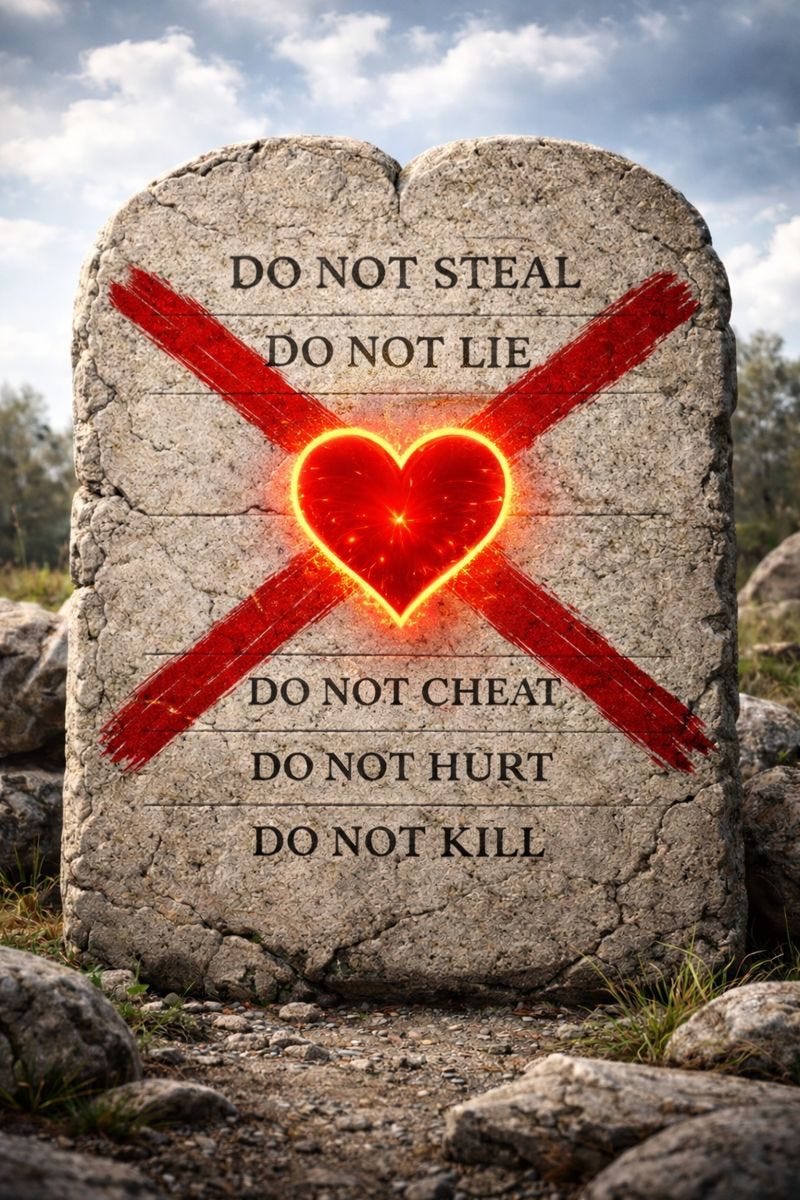
Recently, when the current occupant of the White House was asked by a reporter if there were any constraints on his global powers, he answered: “Yeah, there is one thing. My own morality. My own mind. It’s the only thing that can stop me.”
Absolutely, I muttered under my breath. Then I caught my breath; aghast to be in full agreement, and without hesitation!
Unfortunately, the reporter was not allowed to follow up with that obvious, rhetorical question that often seems to be totally missing from any news coverage of most political debate or power plays on the world stage; namely, what are those morals? Have you no moral scruples? That is, what is the moral basis for anyone’s actions; both in mind and spirit?
Every spiritual tradition – and political persuasion, for that matter – claims to have a presumed moral basis, or foundation. There’s a moral code, for instance; like, say, ten commandments (Ex.20), or perhaps some beatitudes enumerated by a hillside preacher (Mt. 5). And, then there’s always the seeming exceptions made to the rule; to allow the human mind -- like my brother Donald’s mind, or mine -- to rationalize and deviate, with alleged justification. So, how does one square it all? Can you?
Personal Choice and the Missing Rhetorical Question:
Whither the Goldmine?
In the Judeo-Christian biblical tradition there is the Pentateuch, constituting the first five books of the canonical Bible; wherein can be read the Book of Leviticus (1400 BCE). It is a long, long list of do’s and don’ts, known as “purity laws”; constituting and enumerating a certain moral code for those adherents who would choose to follow it.
For instance, one is commanded to leave some harvest remnants in your fields and vineyards for the poor (Lev. 19:10). And, don’t curse the deaf and blind (Lev.19:14). Good enough. But it’s also forbidden to let your cattle “gender with a diverse kind “ (Lev.19:19), or put to death a man’s betrothed female if she’s had sex with another male against her will (Lev.19:20). Hmmm.
And, then there’s this meddlesome passage, which could be quite problematic nearly four centuries later if one were to read the headlines today, with regards to what’s currently happening in Minneapolis, Minnesota:
“And if a stranger sojourn with thee in your land, ye shall not vex him. But the stranger that dwelleth with you shall be unto you as one born among you, and thou shalt love him as thyself; for ye were strangers in the land of Egypt: I am the Lord your God.” (Lev. 19:33-34)
Nearly two thousand years ago, there was once an itinerant Galilean peasant sage / teacher named Jesus; an historical figure who would have been well-versed in those ancient scriptures, including Leviticus.
Similar sayings attributed to him are, “Treat people in ways you want them to treat you.” (Mt. 7:12) and “Love your neighbor as yourself.” (Mk. 12:31, Lk 10:28).
Those who had ears to hear what Jesus said then proceeded to ask the rhetorical question, “And who is my neighbor?” (Lk. 10:29) To which, of course, Jesus replies with the tale of “The Good (alien) Samaritan” (Lk.10:30-35).
Commonly known today as the “Golden Rule,” this moral rule underlying that story is actually a familiar piece of ancient lore from multiple traditions. For example, in the Book of Tobit, that 3rd century character combined Jewish piety and morality that mined the depths of human experience to discover and reiterate the admonition, “What you hate, don’t do to someone else.”
So why is it that the obvious, rhetorical question about what truly constitutes one’s moral basis for one’s actions is rarely posed, or answered?
The 2-Step, or the Side-Step?
Well, it all depends …
Shall we dance?
On a bright cloud of music
Shall we fly?
Rogers & Hammerstein, 1951
The previously mentioned, current occupant of the White House seems prone to demolish and replace things in his own image. This includes the East Wing of his current residence, where he’s building himself a new ballroom. It might lead one to wonder if he’s looking forward to doing the two-step, or just another side-step; when it comes to the underlying question of his moral behavior?
When I was a much younger man -- and more adept on the dance floor myself -- I read a newly-published book by the American Anglican theologian, Joseph Fletcher, entitled “Situation Ethics: A New Morality” (1966). The book’s premise suggested that instead of a strict adherence to a rigid set of old rules (or, say, commandments) that the basis for one’s choices and conduct be set not only by the particular circumstances of each situation; but their consequential outcome, as well. Terms like “moral relativism” and “consequentialism” came into vogue; in an endless effort to counter the seemingly-naïve idealism with what I’d call the pragmatist’s claim to what’s “real.” Human nature seems inherently intent on clinging to the disclaimer, “well … it all depends.” Some examples:
In the “real” world of endless turf wars, there’s Russia’s aggression in Ukraine, or Israel’s disproportionate retaliatory violence in Gaza. Then there’s “land grabs;” with the latest example being what one might call the Greenland “side-step.’” How do such choices not only confront and challenge the ethical conduct of national leaders; but -- more importantly for the average nobody -- one’s individual personal moral choices in assessing it all?
The 18th-century German philosopher, Immanuel Kant, argued there was a “moral imperative” that was a non-negotiable responsibility to act in a certain way. It applied to both individuals, as well as communities and national identities. If such a line exists, how can our human free will constrain our choice to cross it?
I have reflected and written several commentaries about the oft-perceived naiveté of the Galilean peasant sage Jesus; when the “real” world perpetually dances to a different tune (here, here, here). Even the compendium of Judeo-Christian scriptures – a humanly-constructed document – forbids killing in some verses, while elsewhere allowing for an eye-for-an-eye form of retaliatory violence.
There is that injunction from Deuteronomy, “I have set before you life and death, blessing and cursing: therefore choose life.” (Deut 30:19-20). The underlying rhetorical question to that injunction might best be what constitutes true living, and not merely existing.
With that consideration, I return once again to that essential question, posed to Jesus in Luke’s gospel (Lk. 10). The inquisitor recognizes Jesus as one well-versed in all those ancient commands, purity laws, and moral codes of scripture. Jesus responds by having the inquisitor recite their shared version of the golden rule, and loving neighbor as one’s self. “Do that,” the sage replies, “and you will live.”
Not satisfied with the command alone, the rhetorical question that lies at the heart of all those moral codes is asked, “And, who is my neighbor?” The Tale of the Good Alien is then spun for those who still want to not merely exist, but truly live with a heart of gold.
© 2026 by John William Bennison, Rel.D. All rights reserved. This article should only be used or reproduced with proper credit.To read more by John Bennison from the perspective of a Christian progressive go to the Archives.
John, I really appreciated this piece. You hit on the one question most of us spend a lot of time trying to dodge by overcomplicating it: "Who is my neighbor?"
It’s easy to be a "neighbor" to the person next door who looks like us or the folks who share our politics. But you stripped away those comforts. I liked how you tracked that moral line from the old purity laws of Leviticus straight through to the "Good Alien" on the road to Jericho. It lands in a place that’s getting harder and harder to ignore these days. Being a neighbor isn't about geography or tribal loyalty; it’s a universal responsibility that includes the stranger, the environment, and even the people on the other side of a fence.
We’re seeing so much "side-stepping" right now—people rationalizing their way around basic human decency because they claim "it all depends" on the situation. Your post reminded me that "choosing life" isn’t just about surviving or winning an argument; it’s about the moral scruples that keep us human.
If we only look out for our own, we’re just existing. Truly living takes the kind of courage you’re talking about—the courage to see the world as one neighborhood and actually act like we belong to it. Peace.