


For days, outside my window, the towering trees surrounding my perch have been swinging and swaying like a giant dance troupe totally out of step with each other. But awakening one morning, I found a giant branch had splintered from its trunk; and lay dead and motionless on the ground. Being one who’s inclined to read something more into almost everything that happens, I paused to ponder what kind of metaphorical meaning I might draw from such a common occurrence.
Just as there is a virtual windfall of expressions to describe the root meaning of this one word (wind, breath, spirit), so too there are all the various religious traditions that draw upon such natural occurrences to try to aptly describe the ephemeral or ineffable.
Biblical scholar, Brandon Scott wrote a recent article, “Blowin’ in the Wind,” asking the question, “When did “spirit” become the translation for the Greek pneuma? The answer,” he writes,” while not difficult, has profound implications.” [1] He goes on,
“The Hebrew word ruach (ר֣וּח) means wind, breath, air. The Greek word pneuma (πνεῦμα) means wind, breath, air. The Latin word spiritus means wind, breath, air. The Hebrew, Greek, and Latin all have the same primary meaning. Wind, breath, and air are all aspects of the same thing and constitute the primary usage in each language. This pneumatic phenomenon has some interesting characteristics. It can be felt but not seen. The presence of breath in a mammal indicates life; its disappearance indicates death. These aspects enable wind-breath-air to function as a metaphor for the presence of the mysterious or divine.”
So, there seem to be as many human expressions that have attempted to define a ‘spirit’ as there are those futile efforts to grasp the wind. Within the Christian faith tradition there are such tempestuous examples; worthy of revisiting and exploring that deeper meaning to which such stories allude.
The title to Scott’s article, of course, is properly attributed to the song by the twangy folk artist / singer Bob Dylan. When I was strumming and singing his song in my youthful days (the “sixties,” last century), my preacher/father taught me what the use of such a word could mean to describe the divine; with the orthodox trinitarian formula of the Father, Son and Holy Spirit.
But being a rebellious young peacenik during the civil rights era, I wanted to instead believe the times they were a’changin.’ Otherwise, all the efforts to try to change and improve the human spirit remained elusive, at best. Now, in my older years – after seeing our weary historical human cycle repeat itself over and over again -- I have to sometimes wonder if that “answer, my friend,” may still be just blowin’ in the wind?”
There seems to be as many human expressions that have attempted to define a ‘spirit’ as there are to grasp the wind: Breath, breathless, or breathe new life into something or someone’s last breath, or be dead still. There’s the blowhard, dismissing any effort to stir the slightest breeze; and instead simply responding, “go fly a kite!” Or, try sailing a boat and you’ll quickly learn terms like windward, windfall, headwind, and a dead calm, without a stick of wind. And, perhaps most important, is knowing when it’s time to quickly and completely come about in the other direction.
Perhaps most important, is knowing when it’s time to quickly and completely come about in the other direction.
But don’t be dispirited! Just as Dylan also gave us the line form another one of his songs, “It don’t take a weatherman to know which way the wind blows.”
A True Miracle: How to Come About
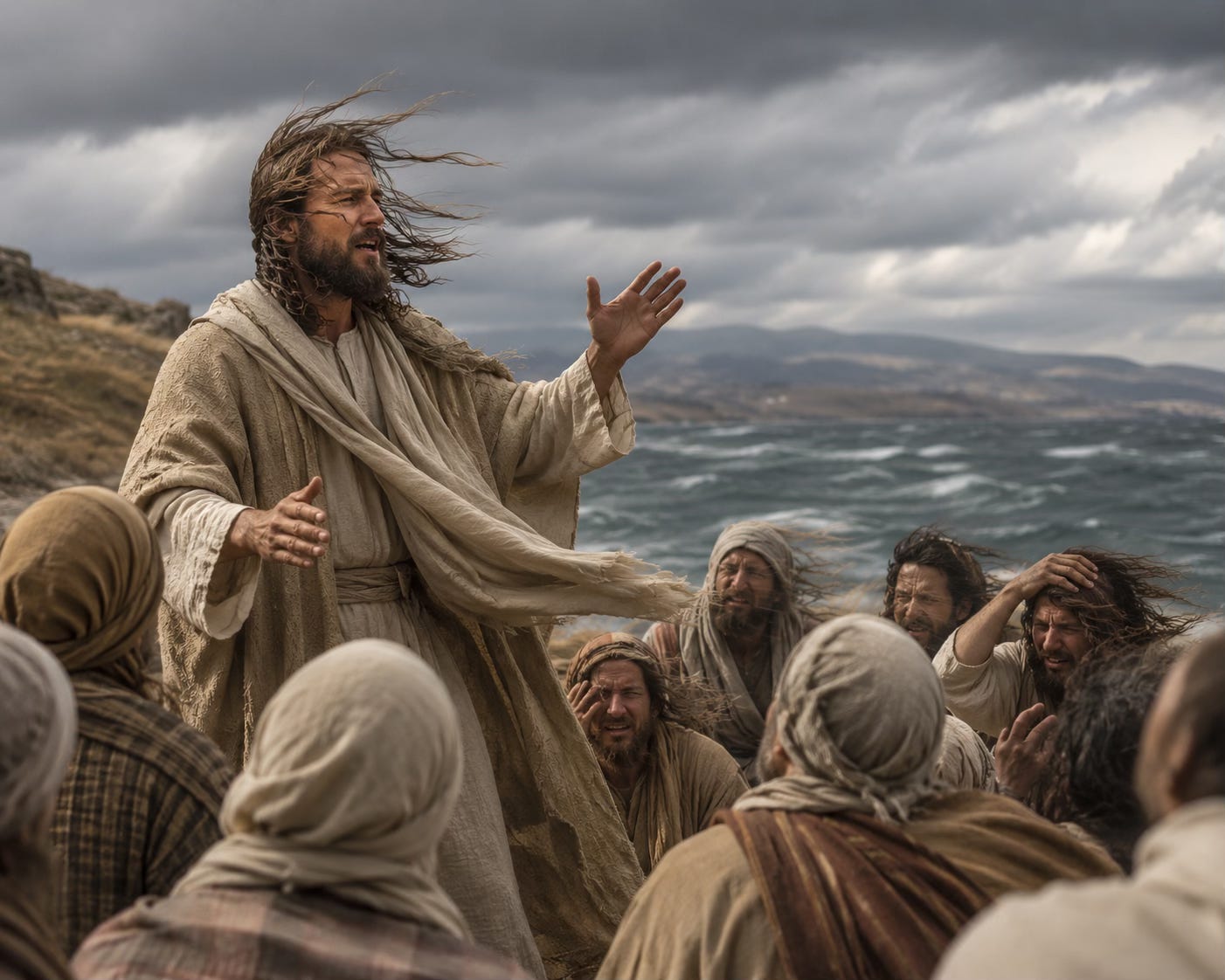
Toward the beginning of the earliest canonical gospels (Mark 4:33-41), the tale is told of Jesus in a boat with his disciples; after teaching a larger group of listeners who could presumably only understand the meanings of his teachings with the use of metaphors. He’s now sound asleep in the boat’s bow, as the ship is about to be capsized by a tempestuous wind. He’s awakened by his own desperate disciples, pleading with the question which one could interpret both literally and metaphorically: “Don’t you care that we are going to drown?” they shout.
Jesus commands the wind to cease, and a dead calm ensues. His action is interpreted by the disciples as a miraculous act that can control a natural occurrence. But if a windstorm is to be interpreted metaphorically, it’s Jesus’ question which is then posed to his alarmed followers who still dwell in mortal fear, “Why are you so cowardly?, he asks, “You still don’t trust, do you?” (Jesus Seminar translation). That is — I suggest he he was asking — you still don’t believe there’s another direction, do you?
On Land or Sea, It’s Still a Dustbowl
So, what’s this blustery old tale got to do with us, in a world today blown hither and yon? Well, try sailing your own ship of the state we’re in through the Strait of Hormuz. Then ask the question if there isn’t a better direction?
I recently learned watching a news source I trust (PBS Evening Newshour) that Portugal captured the strait in 1507; controlling that same trade route until Persia’s Safavid dynasty took it over in 1622. Hmmm … Centuries later it appears we still have trouble changing course. Wonder why?
From the Hebrew scriptures here’s just one of several similar passages that reiterates what is also referred to as lex talions (the law of retaliatory violence):
And if any mischief follow, then thou shalt give life for life,
Eye for eye, tooth for tooth, hand for hand, foot for foot,
Burning for burning, wound for wound, stripe for stripe. (Exodus 21:23-26)
Then, from probably one of the most authentic passages in the New Testament that’s attributed to the historical Jesus, from the Sermon on Mount:
(Jesus said): “As you know, we once were told, ‘An eye for an eye’ and ‘A tooth for a tooth.’ But I tell you: Don’t react violently against the one who Is evil: when someone slaps you on the right cheek, turn the other as well. (Mt. 5:38-39)
Then this last week, the U.S. Secretary of War and avowed Christian conservative, Pete Hegseth quoted the current occupant of the White House; in response to a reporter’s question about the escalatory violence against Iran in that same Strait of Hormuz:
“The president’s policy is a head for an eye,” he said. “I mean honestly, that’s what it’s going to be. I mean, they will pay a very heavy price for the things they’re doing.”
So, once every body part is dead and gone — both literally and figuratively — where do we go from there?
Just Dust in the Wind? The Last Word
Same old song
Just a drop of water in an endless sea
All we do
Crumbles to the ground, though we refuse to see
Dust in the wind
All we are is dust in the wind. (Folk-Rock group, Kansas, 1977)
Lastly, there’s that other gospel tale from early oral tradition that is meant to transport us beyond the literal, in order to try to still point us in the right direction:
Nicodemus said to him, “How can a man be born when he is old? Can he enter a second time into his mother’s womb and be born?” Jesus answered, “Truly, truly, I say to you, unless one is born of water and the Spirit, he cannot enter the kingdom of God. That which is born of the flesh is flesh, and that which is born of the Spirit is spirit. Do not marvel that I said to you, ‘You[d] must be born again.’ The wind[e] blows where it wishes, and you hear its sound, but you do not know where it comes from or where it goes. So it is with everyone who is born of the Spirit.” (John 3:1-21)
It’s a miraculous metaphor, of course, for that true miracle that is still yet to be realized. It is that faith in Jesus’ message, his life and teachings, that could yet still the tempestuous storm that still rages.
That is the answer, my friend, that’s still blowin’ in the wind.
[1] “Blowing in the Wind,” by Brandon Scott, The Jesus Seminar
© 2026 by John William Bennison, Rel.D. All rights reserved. This article should only be used or reproduced with proper credit.
To read more commentaries by John Bennison from the perspective of a Christian progressive go to: