


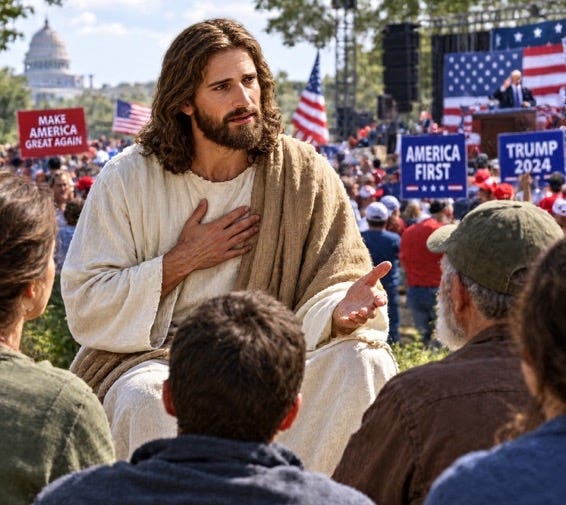
In my last commentary in this series here entitled, “Its (Not Just) the Economy, S(-----)!,” I suggested that the recurrent political pendulum in the U.S. election cycle typically revolves around pocketbook, kitchen table issues more than anything else. But there resides something even deeper and more profound in the core teachings and life example of the one known as the Galilean peasant sage, Jesus.
Still, political candidate’s best chances still seem to hinge on campaign dollars spent, any as-yet undisclosed scandals, name-calling, or fluctuating prices at the gas pump or supermarket. Seemingly absent from candidate debates, pollster’s survey data or the media’s endless roundtable jostling is any mention of what might be loosely deemed to be a candidate’s clearly discernible moral conscience.
As I was composing this last sentence, I was interrupted by a phone call from someone presumably conducting an opinion poll of California voters. I deferred and hung up. Since I personally do not reside in any competitive “swing district,” I can claim to put my political bias aside in my further remarks here. While I don’t doubt the vote I cast will be counted, it may not count for much more than assuaging my conscience .
Conscience vs. “Unconscience-ness”
Recently watching yet another outrageous move by a political leader I caught myself muttering aloud, “Has he no conscience? No moral scruples?” Then I had to stop short and ask myself what in this world I meant. Taking even a shallow dive into the etymological root meaning of such terms can be informative.
Conscience presumably helps one distinguish between what one considers to be right, or wrong; without equivocation or backpedaling. It is the basis for any moral “code;” that is, the rules by which one lives their life. To remain oblivious to such a life “structure” is to be “un-conscience,” i.e. lacking a consicence. As such, knowingly and deliberately ignoring any such moral code is what is deemed to be “unconscionable.”
Spiritual CPR: Reviving the Unconscious-ness
In Matthew’s canonical gospel (Mt. 23), there is an episode that is replicated in other New Testament versions. A central portion of the story is deemed by some learned biblical scholars to likely either be something the historical Jesus actually uttered in the presence of his followers and opponents; or was at least subsequently related that rang true and sounded like something he likely would have said.
As we know, Jesus was repetitively at odds with the religious authorities of his day; calling them out, again and again, for what he declared was their misrepresentation or neglect of their religious tradition’s moral code, the Torah. These were the divine rules that constituted a moral code by which they were to live their lives.
Then Jesus said to the crowds and to his disciples, “The scholars and Pharisees occupy the chair of Moses. This means you’re supposed to observe and follow everything they tell you. But don’t do what they do; after all, they’re all talk and no action. They invent heavy burdens and lay them on folks’ shoulders, but they themselves won’t lift a finger to move them. Everything they do, they do for show. So they widen their phylacteries (a leather box containing passages of the Torah) and enlarge their tassels. They love the best couches at banquets and prominent seats in synagogues and respectful greetings in marketplaces, and they like to be called ‘Rabbi’ by everyone.” (Mt. 23:1-7 Jesus Seminar translation)
Since politics and religion are often indistinguishable in the way they get structured and function, I would suggest it’s not difficult to substitute those in authority in Jesus’ day with some of those in positions of political power today. It’s not just a matter of similar sheer audacity when it comes to blatant misrepresentation of fact, fancy banquets or ballrooms; but more important, to ask the underlying question Jesus was implying. That is, where — in this torn and tattered world — is one’s moral conscience?
Taken metaphorically, or even figuratively – as Jesus often beckoned his followers to do – he demonstrated by his life and example how to truly conduct a form of spiritual CPR (i.e., cardio revival), when one is found to be un-conscious. That is, to recognize and feel compelled to act when the heart of an essential moral code – as defined by this one of many comparable spiritual traditions – needs to be revived.
© 2026 by John William Bennison, Rel.D. All rights reserved.
This article should only be used or reproduced with proper credit.
To read more commentaries by John Bennison from the perspective of a Christian progressive go here.